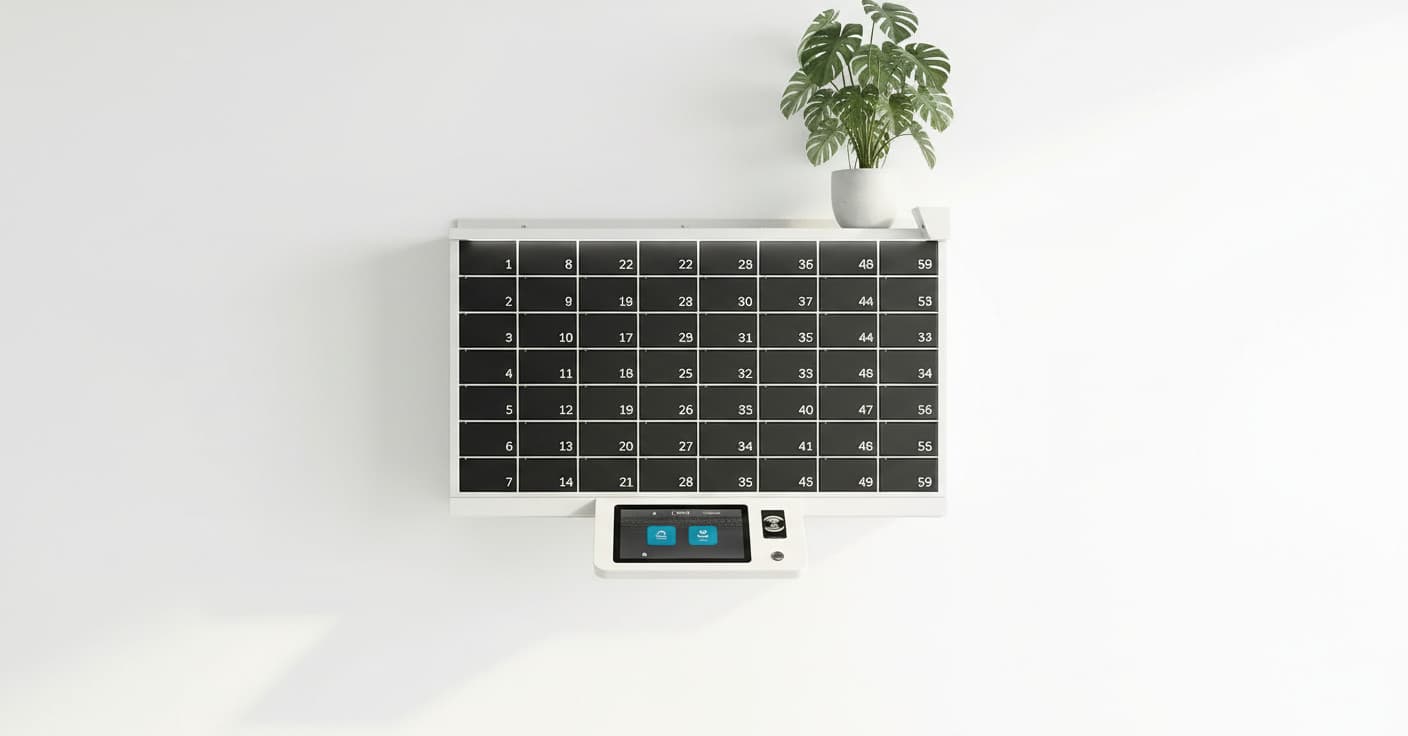
Corporate fleet management almost always breaks at the same point: the keys. They sit in a drawer with an administrator, with the building superintendent, or in a safe everyone knows the code to.
The result is drivers waiting, vehicles idle while others rack up mileage, and zero ability to answer who drove this car on Tuesday evening.
From manual handout to automatic allocation
In the manual method the driver asks for a vehicle, someone decides which, and hands over a key. In the automatic method the driver identifies themselves at the terminal, and the system picks a vehicle for them according to preset rules.
Those rules are where the value sits. You can define a rotation that always issues the least-used vehicle, spreading wear evenly; you can define licence classes, so a driver only gets a vehicle they may legally drive; and you can block a vehicle awaiting service.
- Automatic rotation spreads mileage across the fleet.
- A driver only receives a vehicle matching their licence class.
- A car in service, or unfit to drive, simply isn't issued.
- Vehicles can be reserved in advance for a given hour.
What it gives the fleet manager
The question a fleet manager is asked most is who drove the car. With a key management system the answer is a query: who took it, when it left, when it came back.
That changes how traffic tickets, accidents and damage are handled. Instead of asking several people, there is a record. It also changes planning: usage reports show which vehicles are surplus and which are short, and that becomes a budget decision rather than a hunch.
After hours, with nobody at the desk
The most tangible benefit shows up in the hours when there is nobody to hand out a key. A driver finishing a shift at two in the morning returns the key to the cabinet instead of leaving it on a desk, and a driver starting at five takes a vehicle out on their own.
In shift-based organizations that alone justifies the system, which erases the entire coordination layer around key handover.
Frequently asked questions
How many vehicle keys can one cabinet hold?
Capacity is set by the number of positions chosen and can be extended with additional modules. Plan headroom for fleet growth up front. A planned expansion is cheaper than an improvised one.
Does it integrate with our fleet management system?
Yes. The link feeds vehicle status and service state into the system and exports withdrawal logs out of it, so a vehicle awaiting service simply isn't issued.
What if a driver returns the wrong vehicle's key?
Every key's tag is identified on return, so the system detects the mismatch immediately and alerts, instead of it surfacing the next day when someone is looking for a car.